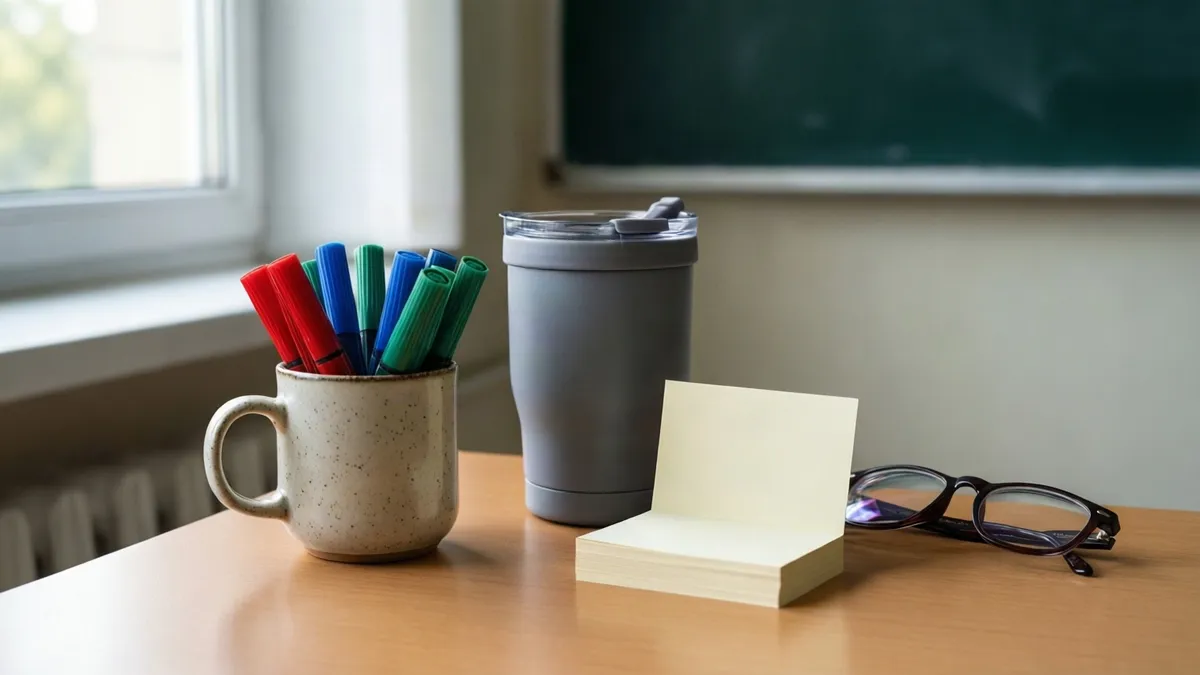
In short: buy for the room, not the job title. A gift that respects the classroom's space, the teacher's specific role, and your family's budget is the one that lands. If it doesn't make the room better or easier to run, it's clutter.
We write buying guides, not reviews. Nothing on this page was tested by us in a classroom. Specs come from the manufacturer or listing, and whatever Amazon shows when you click is the authoritative figure.
This article contains affiliate links. If you buy through one, we earn a small commission at no extra cost to you. We only recommend what we would suggest to a friend.
The Federal Trade Commission's endorsement guides, 16 CFR Part 255, require a disclosure like that one to be difficult to miss, so it sits above every link here. Our full affiliate disclosure has the rest.
A classroom is the smallest workspace most adults will ever shop for. No counter, no cupboard, thirty people through it a day. The best gifts for teachers treat that space like what it is: a shared room with a budget gap, not a desk that needs decorating.
Every store has a shelf labeled teacher. Mugs, apple ornaments, tote bags with the job title printed on them. That shelf is built for the buyer, not for the room. If you have read our Gifts for Teachers That Aren't Another Mug guide, you know the shape. Here is the rule behind it.
Written by the editorial team behind this site, gift researchers who compile buying guides from public sources, manufacturer specs, and customer reviews rather than hands-on product testing.
The Room Rule, explained
The single question that settles every teacher-gift decision: does this make the room better or easier to run? If it doesn't, it's clutter. That is the Room Rule.
A classroom has no counter space, so something used up by June beats something that needs a shelf. A teacher has no storage, so a consumable beats a keepsake. Thirty people move through that room a day, so a tool that saves five minutes helps everyone in it.
You are not shopping for a person whose hobbies you don't know. You are shopping for a workspace you can see through your child's eyes: the markers that dried out, the stapler that jams, the rug the kids sit on for read-alouds.
Teacher Appreciation Week 2026 runs from Monday, May 4, through Friday, May 8, per the United States Census Bureau. National Teacher Day that year falls on May 5. Those dates set the calendar for spring gift season. But the Room Rule works on any Tuesday in October, too.
Here is how common gift categories hold up against the Room Test. The verdict column is our editorial judgment.
| Gift category | Respects the room's space? | Fits the teacher's role? | Respects the family budget? | Verdict |
|---|---|---|---|---|
| Mug or ornament | No, needs a shelf | Generic | Yes | Skip |
| Gift card | Yes, used up | Flexible | Yes | Strong |
| Class library donation | Yes, lives in the room | Fits most roles | Yes | Strong |
| Consumables (markers, snacks) | Yes, gone by June | Fits the room | Yes | Strong |
| Handwritten note | Yes, takes no space | Fits every role | Yes | Best |
Our take: Spend less than you think you should, and give the savings to the room. A pack of markers and a note naming one specific thing the teacher did beats a $30 mug set every time. The one route where spending more actually serves the room is a pooled class gift, because the teacher chooses what fills the gap.
Before you shop: ask the front office one question
Ask before you spend. What your child's teacher may accept is set by state law and district policy, and it varies.
One question to the front office settles it: "Is there a gift policy I should know about?" Asking has never once been the awkward part.
Massachusetts gives a concrete picture of how these rules work. The Massachusetts State Ethics Commission's 2026 guidance states that public school teachers are prohibited from accepting gifts worth $50 or more given because of their position. The same source notes an exception. Parents and students of a class may give a teacher a gift worth up to $150, provided the gift is identified only as from the class.
Gifts worth less than $50 are allowed but must be disclosed in writing if a reasonable person might think the teacher would unduly show favor, per the same commission. Handmade gifts or items worth less than $10 may be accepted without disclosure.
Your state is not Massachusetts. The numbers will differ, and some districts are stricter than state law. For a deeper look at where these rules live, see our Are Teachers Allowed to Accept Gifts? Where Rules Live page. Check your district's handbook for the answer that applies to you.
Private, charter, and homeschool teachers follow different rules. A private school may set its own policy, or none at all. Ask the same question either way.
Filling the physical room: space-savers and consumables
The Room Rule points here first. Classroom supplies get used up, take no shelf space, and fill a gap the teacher is already paying for.
The National Center for Education Statistics reported in its 2018 release that public school teachers spent their own money on classroom supplies without reimbursement. Among these teachers, the average was $478 and the median was $297. About 44 percent spent $250 or less, while 36 percent spent between $251 and $500.
The same NCES report found that teachers at city schools spent more on average ($529) than teachers at suburban, town, or rural schools ($469, $447, and $443, respectively). Elementary-grade teachers spent $525 on average, compared to $430 for secondary-grade teachers. Teachers at schools with 75 percent or more free and reduced-price lunch eligibility spent $550, against $434 at schools with 0 to 34 percent eligibility.
What does that mean for you? A classroom in a city elementary school probably has a bigger supply gap than a suburban high school. The gift that fills it matters more.
Fine-tip dry-erase markers are the classic. They dry out, they run out, and every teacher burns through them. A bulk pack of dry-erase markers disappears into the room by April. Classroom pencil sharpeners and disinfecting wipes fill the same gap.
For a broader list of ideas under $15, our Small Gifts for Teachers Under $15 That Get Used page has the specifics. The principle stays the same: if it gets used by June, it passes the Room Rule.
A consumable that respects allergies is fine. Coffee, chocolate, and snacks work when you know the teacher can eat them. The Massachusetts State Ethics Commission's 2026 gifts guidance notes that candy worth less than $10 falls under the same no-disclosure rule as handmade items. Check with the front office about classroom treat policies, and skip anything scented, because fragrance allergies are real in a room of thirty.
Gifts for teachers in every role: aides, specialists, and the art teacher
Specialists travel. The music teacher pushes a cart between buildings. The PE teacher works in a gym, not a classroom. For them, a consumable that fits in a bag beats anything that needs a shelf.
The school librarian runs a room every child passes through. A donation to the class library in the librarian's name passes the Room Rule perfectly. So does a bookplate with your child's name inside a new library book.
Paraprofessionals and classroom aides are often left out of gift season entirely. They do the work that keeps the room running, and they are paid less than the lead teacher. A gift card or a pooled gift that includes them by name is not an afterthought. It is the Room Rule applied honestly.
Custodians, front office staff, and cafeteria workers keep the building functional. A note and a small coffee card for the person who unlocks the door every morning is a Room Rule gift, because it acknowledges the room they maintain.
New teachers arrive in under-resourced rooms and need starter supplies: a hot glue gun, a small toolkit, magnetic strips for the whiteboard. A starter kit for a first-year teacher is the Room Rule at its most literal.
For more role-specific ideas, our Best Gifts for Teachers: Buy for the Room page breaks it down by position.
Teacher gifts when the whole class gives: the pooled gift that respects every family
A pooled class gift is the strongest route under the Room Rule. It fills one gap in the room instead of twenty small ones, and it lets every family contribute without an arms race.
The Massachusetts State Ethics Commission's 2026 regulations confirm the logic. Teachers may accept class gifts totaling up to $150, provided the gift is identified only as from the class. The class gift exemption exists because pooled giving is treated differently from individual giving under ethics law.
Michigan Governor Gretchen Whitmer proclaimed May 4 through 8, 2026, as Teacher Appreciation Week in Michigan, per the State of Michigan. State-level recognition like this often coincides with school-wide staff gestures, which is another reason to pool.
Organize it so no family feels pressured. Here is the step-by-step:
- Ask the room parent or PTA if a pooled gift is already planned. Do not start a second collection.
- Set a contribution range, not a fixed amount. "Give what works for your family" is the only phrasing that respects every budget.
- Collect anonymously. Use a dedicated pooling platform or a sealed envelope in the front office. No family's contribution amount should be visible to other families.
- Identify the gift as "from the class" only. Do not list individual family names or amounts on the card.
- Include every adult who works in the room. Name the aide, the specialist, the paraprofessional. If the class gift is for the lead teacher only, organize a separate one for the aide.
- Let the teacher choose. A gift card to a store the teacher actually shops beats a well-meaning object the teacher has to store.
For the full logistics, our How to Organize a Class Gift for a Teacher page walks through the details.
Price bands below are ours, not a sourced figure. Most families spend somewhere in the $10 to $25 range for an individual gift. A pooled class gift, split across twenty families, can land at $150 to $200 without any single family carrying it.
What to skip: mugs, scented baskets, and the store's 'teacher' shelf
Skip the mug. A teacher who gets a pack of fine-tip dry-erase markers will use them. A teacher who gets a mug will not.
The store's "teacher" shelf is built for the buyer's guilt, not for the room. Apple ornaments, job-title tote bags, pencils printed with "World's Best Teacher." None of it makes the room better or easier to run.
Scented gift baskets fail the Room Rule twice. They need shelf space, and fragrance allergies are real in a room of thirty children. A candle that smells like vanilla is a hazard in a science lab.
Personalized items with the teacher's name can work, but only when they are consumable. A bookplate with the teacher's name inside a library book passes the Rule. A personalized ceramic plaque does not.
If it needs a shelf, it is probably the wrong gift. If it gets used by June, it is probably the right one.
For holiday-specific guidance, our Christmas Gifts for Teachers: Consumable Beats Decor page applies the same logic to winter break.
The gift that passes the rule: a note about the room
Write the teacher's name correctly. Let the child write in their own hand, even if the spelling is wrong. Name something specific the teacher did: the day they stayed in at recess to help with long division. The book they found for a kid who hated reading. The time they called you about something that wasn't a problem.
A note costs nothing and takes no space. It passes the Room Rule perfectly, because it makes the room better in the only way that outlasts June: the teacher remembers that the work landed.
Our suggested note template (copy and adapt):
Dear [Teacher's name], Thank you for [specific thing they did]. [Child's name] still talks about [specific moment]. You made [subject or activity] feel possible this year. — [Child's name] and family
What is the best gift for a special-ed teacher, paraprofessional, or counselor?
Special-ed teachers and paraprofessionals often work in smaller rooms with sensory tools, fidgets, and calm-down supplies. Consumables that fit that room (sensory items, cleaning supplies, weighted blanket covers) pass the Room Rule. Counselors don't have a classroom at all. A note left at their office door, or a gift card to a coffee shop near the school, respects the fact that their "room" is a portable office. They share it with every student in the building.
How much do most families actually spend on a teacher gift?
We don't have a national survey figure for family spending. Our editorial judgment, based on what room parents report, is that most families land between $10 and $25 for an individual gift. A pooled class gift lets families give less individually while the total lands higher, which is why pooling is the stronger route for a room with mixed incomes.
Are teacher gifts tax-deductible?
No. The Internal Revenue Service does not allow a deduction for gifts to individual teachers. A donation to a public school's general fund may qualify as a charitable contribution, but a gift to a teacher, even one routed through the PTA, does not. If you want the tax benefit, make the donation to the school or district foundation, not to the person.
Do private, charter, and homeschool teachers follow different gift rules?
Yes. Public school teachers are bound by state ethics law and district policy. Private and charter schools set their own rules, which may be more or less restrictive than the public system. Homeschool co-ops have no legal gift framework at all. Ask the school's front office for the policy document by name, and if there isn't one, use your own judgment.
Is it okay to give a teacher alcohol or cash?
Alcohol is risky in any school context, even if the teacher drinks, because the building is a workplace and the gift is visible. Cash is almost universally restricted by public school ethics rules and is best avoided entirely. A gift card to a store the teacher shops is the cleanest substitute, because it functions like cash without the ethical gray area.
What should I do when a teacher says "no gifts" but the PTA is still collecting?
Respect the teacher's request individually. A handwritten note is not a gift in any policy sense, and it is the one thing the PTA cannot collect for you. If the PTA is pooling for a class gift identified as "from the class," that may fall under the class gift exemption in your state. However, the teacher's "no gifts" stance should still be honored directly. When in doubt, ask the front office whether the PTA collection is a school-sanctioned exemption or a parent-organized gesture.
What are the actual teacher-gift legal limits in my state?
Only your district handbook can answer that. Massachusetts sets a $50 individual limit and a $150 class gift exemption, but your state's ethics commission or legislature sets its own thresholds. Some states have no statutory dollar figure at all and leave it entirely to district policy. Call the front office and ask for the gift policy document by name.
Maggie Torres writes buying guides, not reviews; nothing here was tested by us.
Sources
- Massachusetts State Ethics Commission — "Conflict of interest law explanation for Public School Teachers" (https://www.mass.gov/info-details/conflict-of-interest-law-explanation-for-public-school-teachers) "Retrieved 2026-08-24".
- Massachusetts State Ethics Commission — "Conflict of Interest Law Regulations and Exemptions relating to Gifts and Gratuities" (https://www.mass.gov/info-details/conflict-of-interest-law-regulations-and-exemptions-relating-to-gifts-and-gratuities) "Retrieved 2026-08-24".
- Massachusetts State Ethics Commission — "Gifts to Public School Teachers and Staff" (https://www.mass.gov/info-details/gifts-to-public-school-teachers-and-staff) "Retrieved 2026-08-24".
- United States Census Bureau — "National Teacher Appreciation Week and Day: May 4-8 and May 5, 2026" (https://www.census.gov/newsroom/stories/teacher-appreciation-day-week.html) "Retrieved 2026-08-24".
- State of Michigan, Office of Governor Gretchen Whitmer — "May 4-8, 2026: Teacher Appreciation Week" (https://www.michigan.gov/whitmer/news/proclamations/2026/05/04/may-4-8-2026-teacher-appreciation-week) "Retrieved 2026-08-24".
- National Center for Education Statistics — "Public School Teacher Spending on Classroom Supplies" (https://nces.ed.gov/pubs2018/2018097/index.asp) "Retrieved 2026-08-24".
- Federal Trade Commission — "Guides Concerning the Use of Endorsements and Testimonials in Advertising" (https://www.ftc.gov/legal-library/browse/federal-register-notices/guides-concerning-use-endorsements-testimonials-advertising) "Retrieved 2026-08-24".